Join Our Team
Black EPDM vs. White TPO Roofing in Metro Detroit: Which Commercial Roof Performs Best in Michigan’s Climate?
May 8, 2026
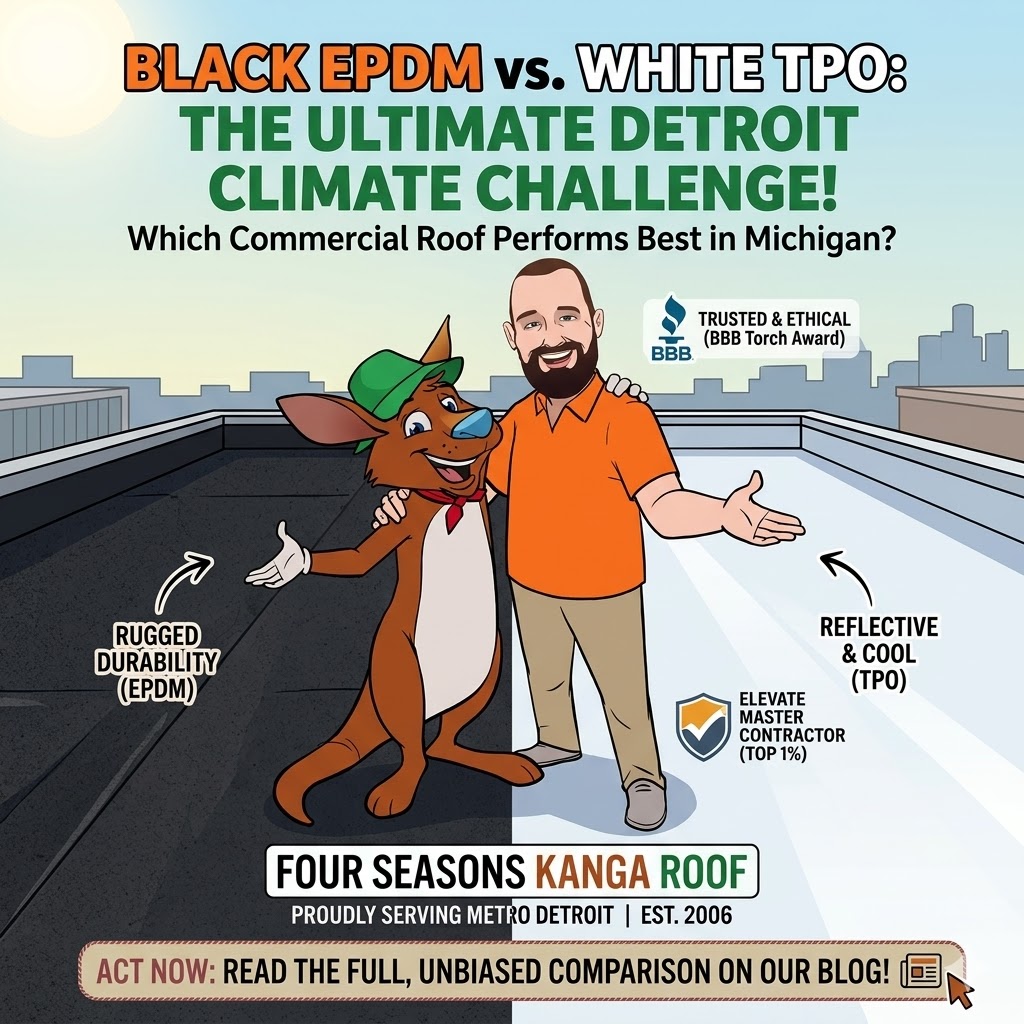
The Ultimate Commercial Roofing Showdown: Black EPDM vs. White TPO in Metro Detroit
How does a black EPDM roof compare to a white TPO roof when battling Michigan’s notorious extreme climate swings? If you own or manage a commercial property—be it in Macomb, Oakland, or Wayne County—the answer is critical, especially as your building size increases. Here at Four Seasons Kanga Roof, we understand that “best” isn’t a one-size-fits-all answer. Does “best” mean the longest lifespan? The most energy-efficient? Or the system with the fewest commercial roof leaks?
That’s why we’ve put together this definitive breakdown. Our goal is to help Metro Detroit property owners like you review the performance of each system to align your roofing choice with your long-term goals and budget. This way, you know exactly what you are investing in.Performance Comparison: TPO vs. EPDM for Michigan Commercial Roofing
Up first is our comprehensive commercial roofing performance comparison chart. We encourage you to review each point, as the optimal choice for your building hinges on a combination of these factors.
| Feature | White TPO (Thermoplastic Polyolefin) | Black EPDM (Ethylene Propylene Diene Monomer) |
| Thermal Stress | Superior. Reflects up to 80% of UV rays, keeping the membrane closer to ambient air temperature. This reduces the massive thermal shock common in Michigan. | Poorer. Can reach 170 degree Fahrenheit on a sunny Michigan day, leading to significant expansion and contraction stress on the system. |
| Seam Strength | Superior. Seams are heat-welded, creating a monolithic bond stronger than the membrane itself. This is a huge advantage in our freeze-thaw cycles. | Lower. Relies on adhesives/tape, which are the most common failure points, especially during extreme temperature swings. |
| Cold Flexibility | Good. Remains flexible, but some older formulations could become brittle in extreme sub-zero Metro Detroit temps. Newer TPO is highly reliable. | Excellent. Inherently flexible synthetic rubber that maintains elasticity down to -40 degrees Fahrenheit. It’s the “gold standard” for cold-weather movement. |
| Energy Efficiency | Higher. Provides significant AC savings in the summer. The small winter “heat gain” of black roofs is largely negligible when factoring in high R-value insulation. | Lower. Absorbs heat in summer, significantly increasing AC costs. Winter benefits are often offset by snow cover and necessary insulation. |
| Puncture Resistance | Higher. Reinforced with a scrim layer; handles hail and regular commercial foot traffic (HVAC maintenance) better. | Lower. Easier to puncture, though very easy to patch. Regular maintenance is key. |
| Lifespan | 20–25 years. Newer technology with a shorter (but rapidly improving) track record. Expect modern TPO systems to last longer than original specs. | 25–35+ years. Long-standing “gold standard” for material durability and proven performance. |
The Michigan Climate X-Factor: Extreme Winter Temperatures
The extreme winter weather we experience across Macomb, Oakland, and Wayne County is a unique factor that requires special consideration for any large commercial flat roof system.
Again, there is no clear-cut winner, as both materials offer distinct advantages when it comes to combating the cold:
- Thermal Shock (Expansion and Contraction): Our weather can swing from 95 degree days to -10 degree Fahrenheit evenings, putting tremendous strain on a roofing system and its seams. TPO’s heat-welded seams are significantly more resistant to rupture or breakage in these conditions compared to adhesive-dependent EPDM seams.
- Impact/Crack Resistance: Due to its composition, EPDM excels in being resistant to cracking or impacts during the coldest months. Its inherent rubber elasticity allows it to stay pliable even in the harshest -30 degree Fahrenheit temperatures.
A 5-Star Google Review for Four Seasons Kanga Roof:
“Kanga Roof handled the full TPO replacement on our large warehouse in Warren. The crew was professional, the communication was excellent, and the quality of the work was top-notch. They helped us choose the right system to cut down on summer cooling costs. Highly recommend for commercial roofing in Metro Detroit.” – Mark S., Warren, MI
Ready to Find the Best Flat Roof for Your Business?
So, what is the right choice for your commercial building? We would love to help you answer that question.
Our team of certified Metro Detroit commercial roofing experts is ready to provide tailored recommendations. We will happily:
- Perform a complete, no-obligation evaluation of your building.
- Meet with you to understand your specific concerns, budget, and long-term goals.
- Provide our honest, expert recommendations on which system (TPO or EPDM) will perform best for your unique needs.
To get this process started, you can always call our team at 586-566-0308 or skip the line and book online at www.kanga-roof.com/schedule-inspection-now/ (link to our inspection booking page).
If you are just in the preliminary stages of budgeting and planning, be sure to use our exclusive commercial roofing online estimator. It’s completely free, powered by A.I. to build you a custom quote for your building’s needs (including repairs), and allows you to compare the cost differences between EPDM and TPO instantly. To try it out for your commercial building, please visit https://kanga-roof.com/instant-quote-commercial/ (link to our Instant Quote tool).
As always, I hope you enjoyed the article and that you have a Kanga-Rific day!
Sincerely,
Bill Burkhardt, Jr.
VP & Owner – Four Seasons Kanga Roof
Your Trusted Partner for Commercial Roofing in Macomb, Oakland, and Wayne County.
Commercial Roofing FAQ for Metro Detroit Businesses
Q: Is EPDM or TPO better for saving energy in a Michigan summer?
A: White TPO is significantly better for summer energy savings. Its highly reflective surface (high solar reflectivity index) keeps the roof membrane cooler, reducing the heat load on your HVAC system and lowering your air conditioning costs. Black EPDM absorbs heat, driving up summer energy bills but can offer substantial savings in the colder months for heating.
Q: How often should I have my commercial flat roof inspected in Metro Detroit?
A: We recommend a professional inspection at least twice per year: once in the spring to check for winter damage (especially ice-related seam stress) and once in the fall to prepare the roof for the upcoming cold and snow. Regular inspections by a qualified contractor (like Four Seasons Kanga Roof) catch small problems before they become expensive leaks.
Q: Are TPO roof seams truly stronger than EPDM seams?
A: Yes, the seam strength of TPO is superior. TPO seams are heat-welded with specialized equipment, creating a fusion bond that is often stronger than the membrane itself. EPDM relies on adhesive tapes, which are vulnerable to breakdown and failure due to UV exposure and the intense freeze-thaw cycles we experience in Macomb, Oakland, and Wayne counties.
Q: Does the color of the roof matter if I use a lot of insulation?
A: Insulation (the R-value of your roof system) is essential for energy efficiency regardless of the membrane color. With the current energy code of R-30 for roof deck insulation, it has made the energy efficiency between the two negligible. However, a white TPO roof reduces the temperature of the membrane itself, further protecting your HVAC units and the roof system components from extreme thermal stress, which contributes to a longer overall lifespan for the entire roof assembly.

YOUR ROOF MATTERS.
Call our team today to learn more about current specials for your roof.